What Does Web Accessibility Bring to Business?
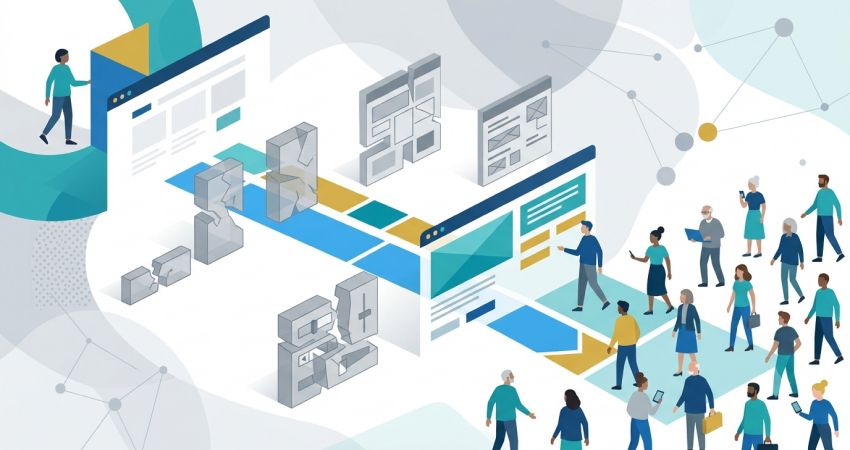
Web accessibility is sometimes perceived as an additional and non-essential feature of a website.
It is sometimes assumed that accessibility is only needed for people with disabilities. As a result, companies may postpone this issue indefinitely or sometimes not consider it at all.
In reality, web accessibility can make a website more convenient for a wider range of visitors and have an impact on business performance.
Web accessibility can affect the following aspects of a business:
- number of visitors
- conversion rate
- customer loyalty
- support costs
- legal risks
Simply put, web accessibility can create opportunities to increase revenue and reduce costs.
We will take a closer look at the impact of web accessibility on business in this article.
How Does Web Accessibility Affect the Number of Customers?
If a website has accessibility barriers, it may lose some potential customers.
The most common stereotype is that web accessibility is specifically needed for people with disabilities — including visual, hearing, motor and other impairments. In reality, the range of people for whom web accessibility is important is much broader. For example, not all people with visual or hearing impairments have disabilities. They may include older people or people with reduced vision.
There are also temporary or situational limitations.
For example, a person with a broken arm has a temporary motor limitation and may find it difficult to use a mouse for a certain period of time.
Examples of situational limitations:
- A mother holding a child cannot use a website in the usual way because only one hand is free.
- A website visitor is in bright sunlight and cannot read low-contrast text on a phone screen.
- A user of an online learning platform is in a crowded place and cannot perceive video content because there is no text alternative.
These examples show that barriers in a product can prevent users from achieving their goals.
Accordingly, applying web accessibility criteria can remove these barriers and open access to a wider audience.
Of course, it is impossible to determine in advance how much implementing web accessibility will affect the number of visitors. It depends on many factors. However, it is clear that an accessible website has significantly fewer barriers for potential customers.
How Does Web Accessibility Affect Conversion?
Visitors do not always leave an inaccessible website.
They may want to place an order, submit a request or register on a platform. However, accessibility barriers may arise at any stage, preventing a potential customer from becoming an actual customer.
Examples of such barriers:
- A form does not work with a keyboard — it is not clear which field has focus, and the form cannot be submitted using the Enter key;
- Errors occur after the form is submitted, but the error messages are unclear and the user does not understand what needs to be corrected;
- Buttons or links have confusing names, and the user does not know what to click to perform the desired action;
- Light text on a light background is very difficult to read, so the user closes the website.
Web accessibility helps remove such barriers, which can contribute to higher conversion rate.
How Does Web Accessibility Affect Customer Loyalty?
Web accessibility requirements are intended to make the experience of using a digital product easier and more pleasant.
Therefore, accessibility generally makes a website more convenient for most users.
A positive user experience can increase the likelihood that a customer will return to the product or recommend it to others.
When a website's structure becomes clearer, it helps visitors achieve their goals more easily.
If form error messages provide clear recommendations for correction, a customer spends less time and frustration filling out the form. Good instructions for completing specific fields also reduce the risk of errors before the form is even submitted.
Therefore, the criteria that make a website accessible also make it more convenient and improve the UX.
How Does Web Accessibility Help Reduce Operational Costs?
The presence of barriers on a website can increase the workload of the support team.
For example, a customer who was unable to place an order on the website may call customer support to place the order by phone.
Implementing web accessibility can reduce the number of such requests because more people will be able to place orders through the website.
To optimize costs, it is also worth considering the stage at which web accessibility is implemented.
A simple rule applies here: the earlier problems are identified, the cheaper they are to fix.
According to
Deque, identifying and fixing accessibility issues early can cost significantly less than fixing them at later stages of development or after release.
This is because web accessibility affects various aspects of a product:
- design and UX
- architecture
- content
- code and UI components
- testing processes
If web accessibility is implemented only after a product is already complete, it may require changes to the design and components, as well as additional testing. This may require more time and money than would have been needed during the design stage.
How Is Web Accessibility Related to Legal Risks?
In some countries, certain types of businesses are subject to legal requirements for the mandatory accessibility of digital products. These requirements may vary depending on the country.
When entering new markets or before launching a product, it is worth checking the legal requirements for web accessibility in the specific country and for your type of business.
Complying with relevant web accessibility requirements can help businesses reduce legal risks.
Therefore, an accessible website or app can create additional opportunities for a business.
In particular, for:
- expanding the audience of potential users
- increasing customer loyalty
- improving product quality and UX
- reducing support costs and the cost of changes to the product
- reducing legal risks associated with non-compliance with accessibility requirements
Web accessibility alone does not guarantee increased sales. However, it removes barriers through which a business may lose users and additional opportunities.
If you would like to check the accessibility of your website, we can help you conduct a web accessibility audit.
Frequently Asked Questions About the Benefits of Web Accessibility for Business
Does a Business Need Web Accessibility If None of Its Customers Have Disabilities?
Yes. Web accessibility makes a website more convenient for a much wider range of users, not just people with disabilities.
Even if none of your customers have disabilities, it is worth checking whether your product creates barriers for potential customers. An inaccessible website may be one of the reasons why some people cannot fully use the product.
Can Web Accessibility Really Affect Conversion?
Yes. Web accessibility affects the ease of using a digital resource. And ease of use can have a positive impact on website conversion rate.
Is It Necessary to Make a Website Fully Accessible Right Away?
If your business is subject to legal requirements regarding the accessibility of digital products, they must be met within the scope prescribed by law.
If there is no such legal requirement, web accessibility should still be considered as early as possible, as this generally reduces the cost of subsequent fixes.
Want to improve your website’s accessibility?
Submit a request with a brief description of your project and goals, and we’ll get in touch.
Our services
Accessible UI components
Reusable, accessible UI components built with semantic HTML, keyboard support, and screen reader compatibility.
View componentsAccessibility Services
Practical accessibility audits, consultations, and support for product teams, designers, and developers
Explore our services